Backplane, by Valaris
A board that agents know how to use.
Coordinate, define and automate across agents and humans.
Explore
- Keeping context in sync live, person to person and person to agent, turns chaotic.
- Every agent runs its own flow and methodology. All traceability is lost.
- Surprise costs at the end of the month.
- Human review arrives late, or once it no longer matters.
The board
One platform. Several ways to put it to work.
Work your cards by hand, from your Codex / CC, or with autonomous Runners that can take on any role you can think of.
- Migrate the session module
- Test coverage on payments
- Update the API schema
- Prune stale dependencies
- Document the ingest flow
- Fix the webhook rate limit
The platform holds the authority
Pipelines, budgets and approval gates live on the platform. The agent cannot route around a control.
Pipelines you define
Every stage carries its own strategy, rules and model. You define the roles your operation needs.
Context injected by code
The platform assembles the prompt with the plan, the review history and the project definition before the model runs.
Cost and control in the open
Every execution records its model, tokens and cost. Budget ceilings and approvals are part of the system.
The platform
This is what you will use.
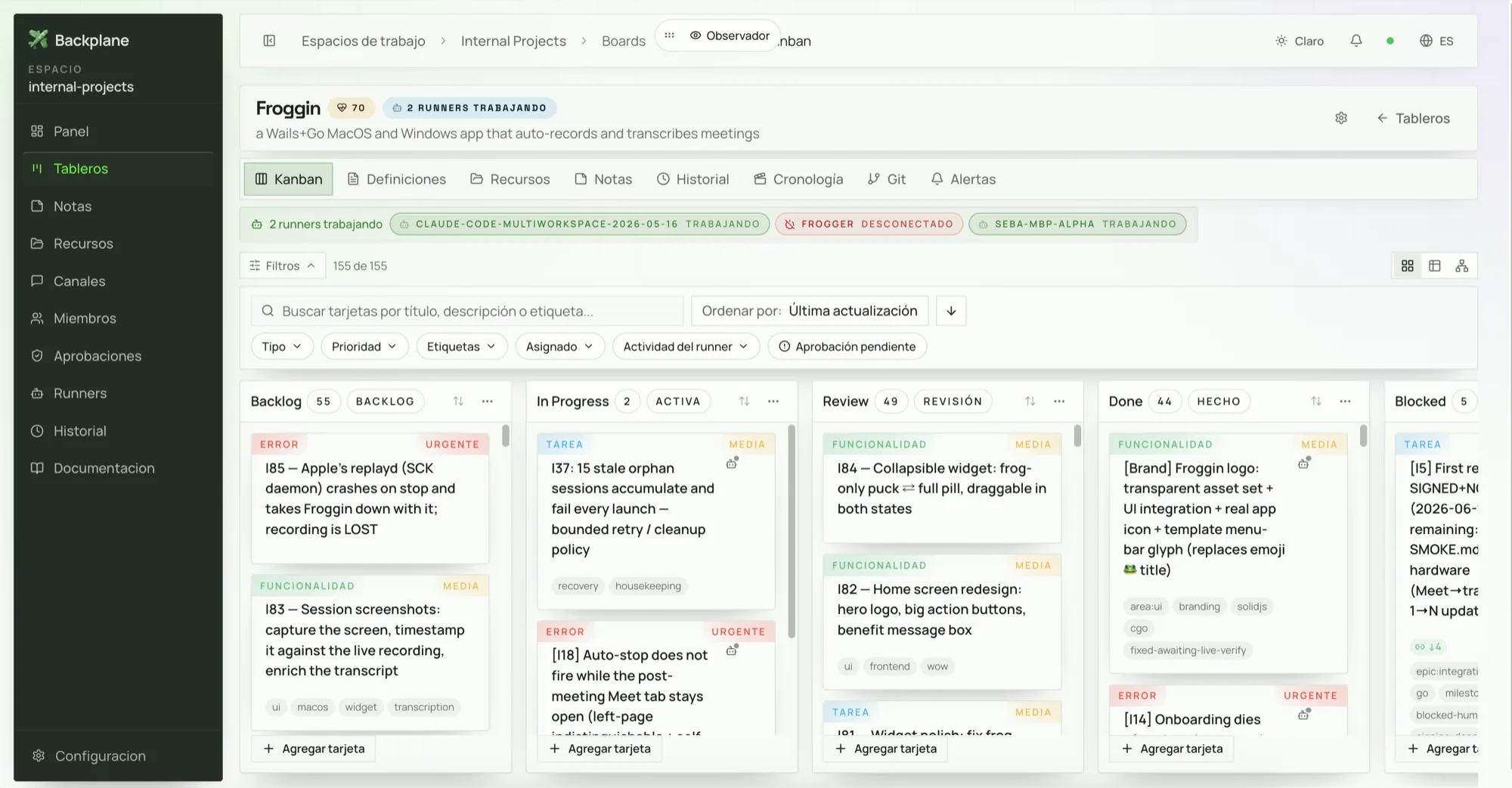
The product at work.
The board, with cards in flight - The situation
- Work that is clear but repetitive, and nobody picks it up because something more urgent always lands first.
- How it is handled
- The cards sit on the board. Runners claim them, work in isolated branches and open pull requests.
- What it leaves behind
- The backlog moves without consuming the team, and every change arrives as a reviewable PR.
- The situation
- Review becomes the bottleneck: the work is done and waits days for attention.
- How it is handled
- A review stage runs over each card against explicit rules and leaves its verdict on the board.
- What it leaves behind
- The human reviewer opens a change already filtered, with the context of what was checked and why.
- The situation
- A sweeping migration touches dozens of files with the same pattern. It is long, and fatigue is expensive.
- How it is handled
- The work is broken into cards with explicit dependencies: ordering comes from the graph.
- What it leaves behind
- It runs in parallel where it can and in order where it must, every step recorded and reversible.
The whole platform, running wherever you decide. Open source, unlimited users.
- The full product loop
- Unlimited users
- Your infrastructure, your credentials
- Works with Claude Code and Codex CLI
We run it with you
Backplane Cloud
A managed instance plus the hands-on work of adapting your repositories to the platform.
- Managed instance
- Expert adoption consultancy
- Cloud-only capabilities and add-ons
- Access control and audit for larger teams
We use what you write only to tell you about the launch and answer your request. Details in the privacy policy.